
The Conditional Flag
This week we explore why a war that ends in a handshake can still leave everyone poorer. Plus: the quiet politics of deciding which flag is worth singing for.

What’s good everyone. I hope we’re all doing well. Honourable mention to the New York Knicks. The joy I’ve seen spreading across the five boroughs of NYC has been so beautiful to see. The World Cup is upon us! The football is back on every screen in every pub, the radio is wall to wall with oil prices, and I have spent the week caught somewhere between the two.
No Clear Victor
A tanker idles at the mouth of the Strait of Hormuz, engines cold, waiting. Then, on the eleventh of June, the order comes. “Ships of the World, start your engines,” Donald Trump posts, and the narrowest stretch of water in global trade begins to move again.
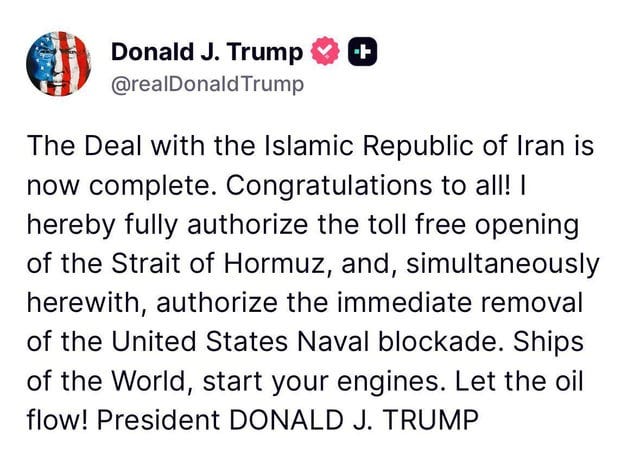
It is a strange image to end a war on, because nobody in this story looks much like a winner. Cast your mind back to the twenty-eighth of February, when the United States and Israel launched Operation Epic Fury, a wave of strikes that killed Iran’s Supreme Leader, Ali Khamenei, and set out, openly, to topple the regime and end its nuclear programme. Iran answered by closing Hormuz, through which roughly a fifth of the world’s oil passes, and by firing on American bases and Gulf cities. What followed was not a clean campaign but a grinding stalemate: a fragile ceasefire in April, an American naval blockade, sporadic strikes through May, and months of stranded tankers while the global economy absorbed the shock.
And what a shock. Brent crude pushed above one hundred dollars a barrel, American petrol crossed four dollars a gallon for the first time in three years, and Moody’s reckons the war has cost American families close to one hundred billion dollars. The International Energy Agency called it the largest supply disruption in the history of the oil market. Iran fared far worse, its economy in free fall.
Now the guns are quiet and the oil is flowing, and you might expect a victor’s swagger. Instead the central question, the one the war was supposedly fought over, sits unanswered. The framework signed this week reopens Hormuz and lifts the blockade, but it punts the nuclear issue into a sixty-day window. Inspectors have not set foot in Iran since last summer, and Rafael Grossi of the IAEA warned that any deal without them is merely the “illusion of an agreement.” Khamenei is dead, but his son now holds his office, and Tehran is calling the whole episode a historic victory.
So let’s tally it up: Iran kept its enrichment ambitions and its regime, at catastrophic cost. America bought a headline and a G7 photograph and paid in inflation, treasure and credibility. Israel, whose prime minister Trump has reportedly been privately cursing, got a ceasefire it did not want. Tacitus, writing of Rome two thousand years ago, put it best: they make a desert and call it peace. We sell wars as decisive but the truth is nobody wins when the (international) family feuds - word to Jay. This one’s ledger shows no clear victor, only loss, spread unevenly across a watching world.
The Flag You Choose
I have always found it hard to sing for a team I am meant to love. Let me tell you when I was fully confronted with the reason.
It is the eleventh of July, 2021. Wembley. Bukayo Saka, nineteen years old, places the ball on the spot in a European final shootout, the weight of a nation on his standing foot. He strikes it. Gianluigi Donnarumma saves. Italy win. And within minutes the abuse begins, a flood of racist filth aimed at Saka, Marcus Rashford and Jadon Sancho, the three Black players who missed.
That, I understood, was the social contract. Do well and you are ours, beloved, draped in the flag. Fall short and the same flag is used to beat you. Support, on those terms, is conditional, and so my own Englishness had always felt conditional too, held at a careful arm’s length.
This squad feels different. Of the twenty-six players Thomas Tuchel has taken to the World Cup, around half are of Black or mixed heritage: Saka and Rashford, Eberechi Eze and Marc Guehi, Ezri Konsa, Kobbie Mainoo and Djed Spence, names carrying Nigerian, Ghanaian and Caribbean stories. Roughly seven per cent of England’s population identifies as Black or mixed heritage. On this team, that share is multiplied by seven.
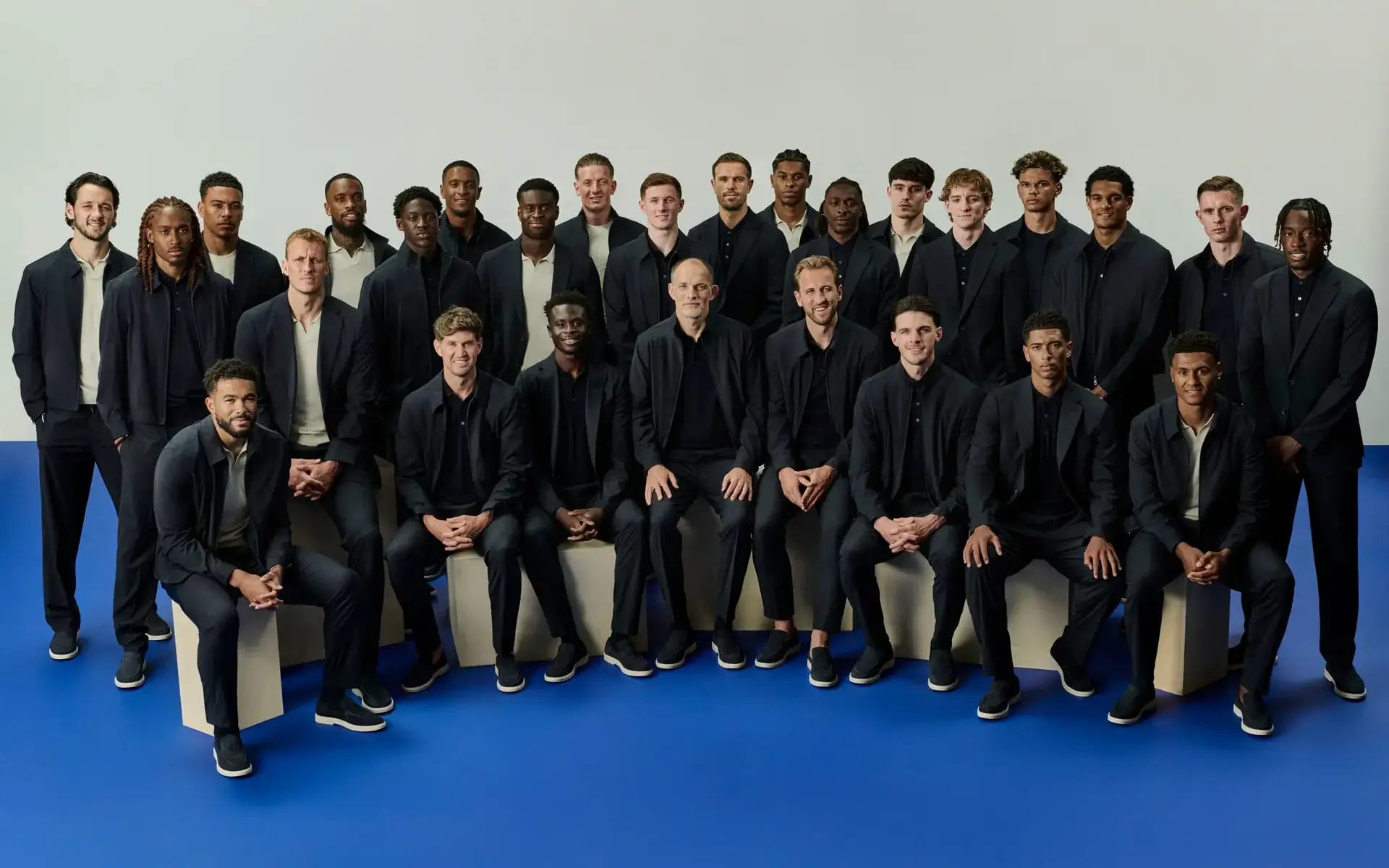
France is even starker, though it takes more work to see. French law forbids the state from collecting any census data on race, ethnicity or religion, a principle of universal secularism the French call laïcité, so the comparison rests on independent estimates rather than official counts. Studies from bodies such as Insee and the Institut Montaigne put the Black and Afro-French population of mainland France at somewhere between 3.5 and 5 per cent. Yet more than sixty per cent of Didier Deschamps’ World Cup squad is of Black or mixed heritage, a representation roughly twelve to fifteen times their estimated share of the population.
The number is not an accident, and neither is England’s. Both squads are drawn far less from the national average than from very particular places. The bulk of France’s talent comes from the banlieues, the working-class and heavily immigrant suburbs ringing its cities, above all the Île-de-France around Paris, now widely regarded as the most fertile patch of footballing soil on the planet. Where the game is cheap, accessible and woven into the daily life of a neighbourhood, the elite academies and eventually the national team come to be populated by its children.
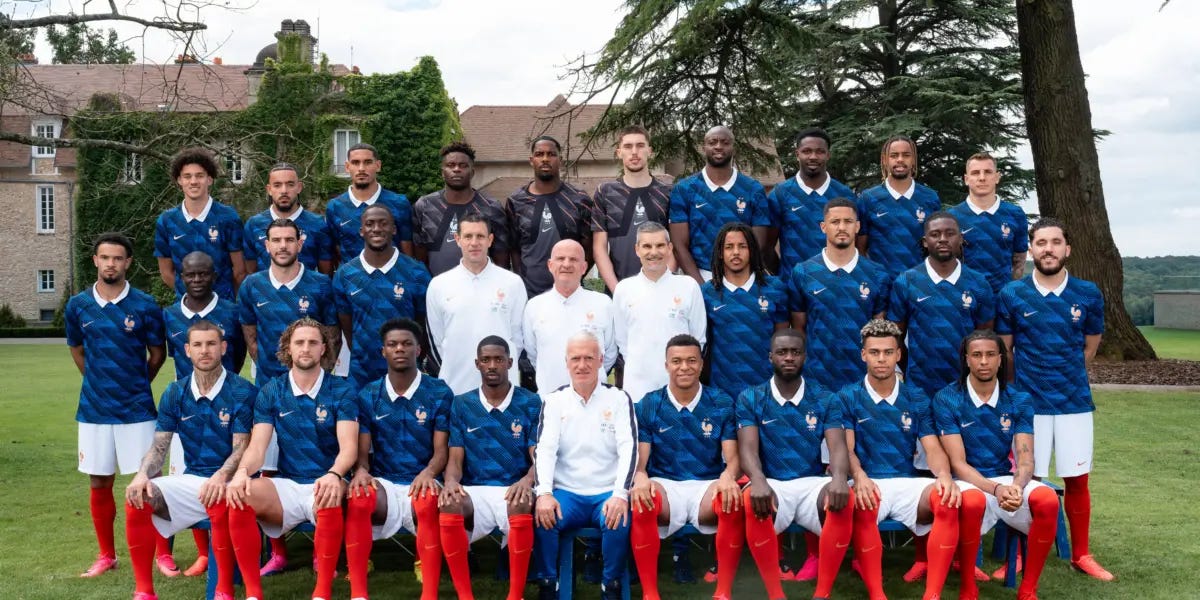
So when people sneer that these teams do not look like the country, they have it backwards. The teams look like a particular, vivid, working-class slice of the country, the diasporic and cosmopolitan slice that I happen to live in. One vision of England and France is narrow, ethnic and nostalgic for a nation that never quite existed. The other is the one I recognise from my own life, where you can be Ghanaian, Mancunian and English all at once without contradiction. That is what these teams look like. And that, far more than the football, is why I find myself, for the first time, wanting to sing. Let’s go England!
Recommends
One recommendation this week, because it is all I have wanted to rewatch. Minutes after the Knicks finally ended their fifty-three-year wait, beating San Antonio in Game 5 to win their first title since 1973, Nike released Sleep Well, NY, a forty-second film directed by Josh Safdie. That speed is the first small miracle: a piece this assured, cut and scored and out in the world while the city was still hoarse, should not be possible. The conceit is almost nothing. A boy in a Jalen Brunson number eleven shirt runs through Manhattan towards Madison Square Garden, the camera handheld and breathless in the way anyone who has seen Uncut Gems will recognise, the city smearing past in blue and orange. Faster runners overtake him along the way, and it does not matter in the slightest, because he gets there in the end and is folded into the same collective exhale as the rest of the city.
What lifts it from good to perfect is the restraint. There is no product, no slogan, no hard sell, just a feeling caught at the exact moment it peaked. The masterstroke is the music. Not Sinatra’s “New York, New York”, not Jay-Z’s “Empire State of Mind”, the two anthems any lesser team would have reached for, but Billy Joel’s “New York State of Mind”, a song that trades triumph for tenderness and carries a nostalgia the obvious choices never could. And then the final frame: a gap-toothed smile widening into pure release, perfectly imperfect, gritty and beautiful at once, the whole city distilled into one face. Bravo. No notes.
Until next week, Peace.
10/10, no notes. also loved the description of the ad and your comment on restraint. had no idea safdie directed the ad but it makes sense that it felt so familiar. this was wonderfully written too.